
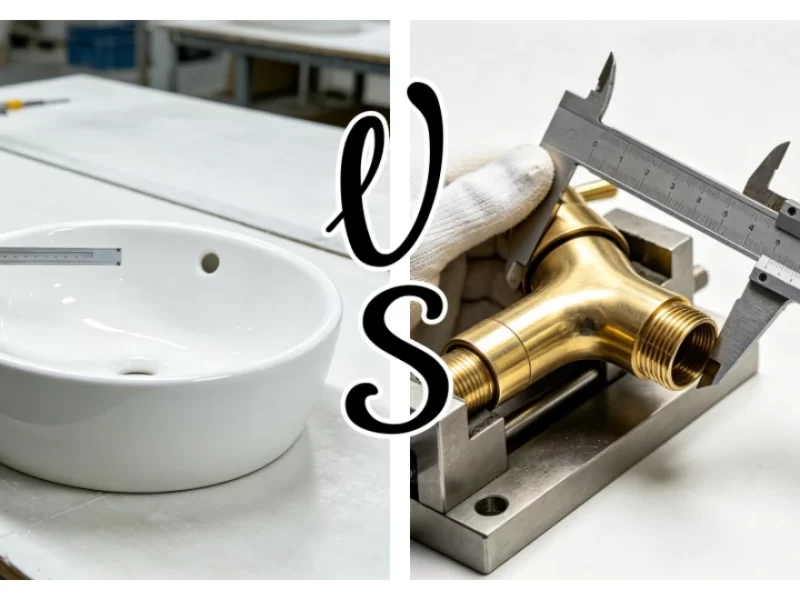
Ceramic basins cannot be manufactured with hardware-level precision. Learn how ceramic basin tolerances occur, what industry standards allow, and how buyers should define acceptable tolerances when sourcing from a ceramic bathroom sink manufacturer.
When sourcing a ceramic basin for residential projects, hotels, commercial developments, or retail distribution, buyers often expect the finished product to match CAD drawings with absolute precision.
This expectation is understandable. Modern design drawings can specify dimensions to 0.1 mm, while product renderings show perfectly straight edges, symmetrical corners, and flawless surfaces. However, a finished ceramic basin is not manufactured in the same way as a precision metal component.
Ceramic products are shaped from clay-based materials, dried, glazed, and fired at high temperatures. During this process, shrinkage and thermal deformation are unavoidable. As a result, ceramic sanitary ware must be evaluated according to appropriate ceramic manufacturing tolerances rather than hardware-level precision.
In short: Ceramic basins are precision-manufactured products, but they are not zero-tolerance products. Dimensional variation within the applicable product standard and agreed specification should not automatically be treated as a manufacturing defect.
This distinction is particularly important for importers, wholesalers, bathroom brands, distributors, contractors, and project buyers working with a ceramic bathroom sink manufacturer.
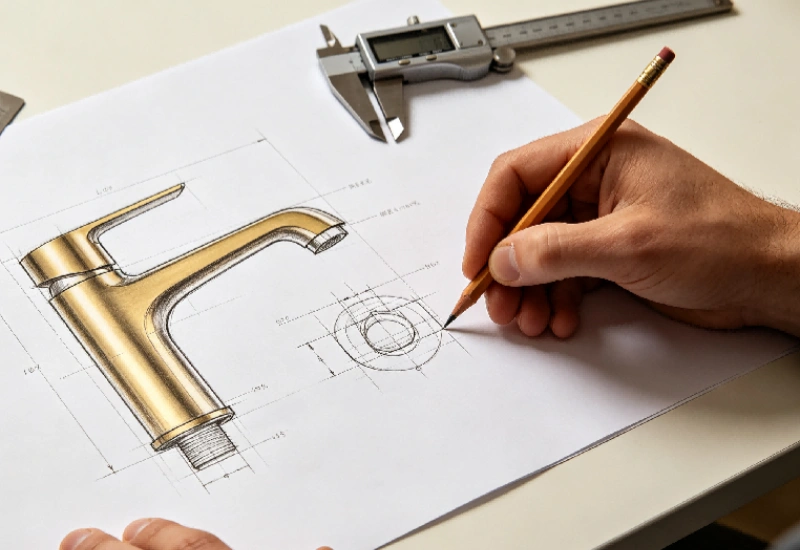
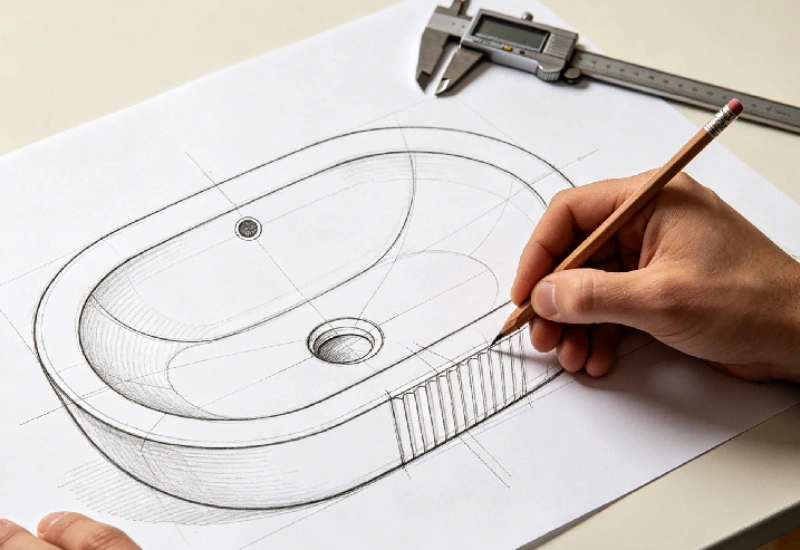
1. Hardware Precision Parts vs. Fired Ceramic Parts
Why can metal hardware achieve much tighter dimensional precision than a ceramic basin?
The main reason is that they are manufactured through fundamentally different processes.
Hardware Fittings: Mechanical Processing
Faucets, screws, brackets, and other metal hardware components are typically manufactured through processes such as CNC machining, turning, cutting, grinding, and drilling.
These processes allow manufacturers to remove material and directly control the final dimensions. For suitable precision components, very small dimensional tolerances can be achieved.

The material does not experience the same type of drying shrinkage and high-temperature firing deformation associated with ceramic production.
Ceramic Basins: Forming, Drying, Glazing, and Firing
A ceramic basin usually goes through several stages:
- Mold preparation
- Slip casting or other forming processes
- Drying
- Green-body trimming
- Glazing
- High-temperature firing
- Inspection and finishing
During these stages, the ceramic body changes physically.
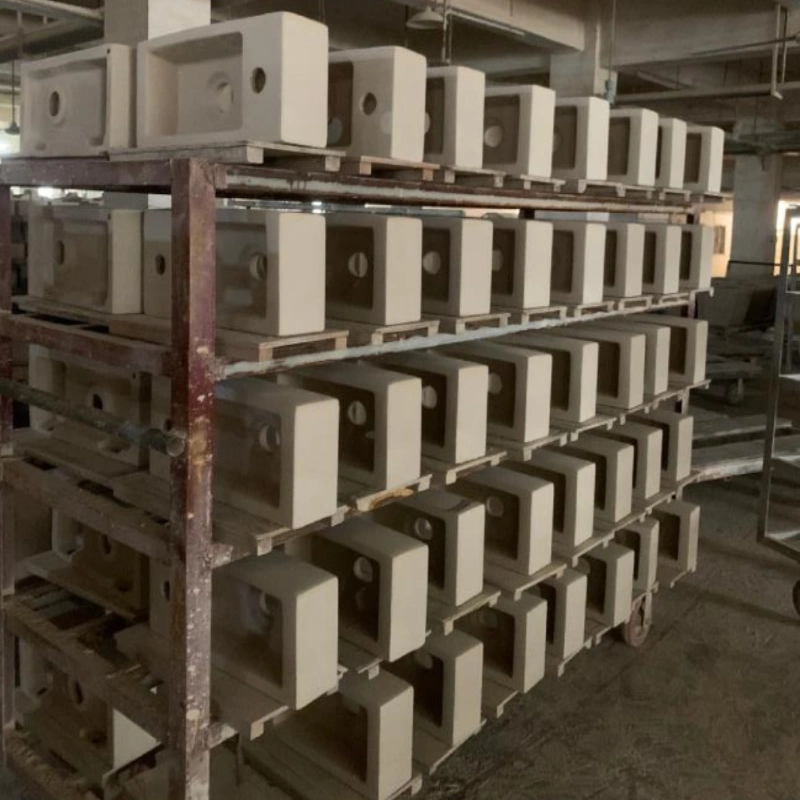
The green body shrinks during drying and firing. At high temperatures, the ceramic material undergoes further dimensional change and can experience slight deformation. Even when the same mold is used, individual finished pieces may therefore show small dimensional differences.
A ceramic basin cannot achieve the same dimensional precision as a CNC-machined metal component because ceramic production involves drying shrinkage and high-temperature firing, while ceramic bodies can also experience slight thermal deformation during firing.
Therefore, comparing a fired ceramic product directly with a precision hardware component is not an appropriate quality benchmark.
2. What Tolerance Is Acceptable for Ceramic Basins?
A key consideration for B2B buyers is understanding that ceramic sanitary ware is manufactured according to product standards rather than a zero-tolerance principle.
China’s GB/T 6952-2015 Sanitary Wares is the relevant national standard for sanitary ceramic products. The standard is currently listed as an existing standard by China’s National Standard Information Public Service Platform. It covers production, sales, installation, testing, inspection, marking, packaging, and other requirements for sanitary ceramic products.
Importantly, the standard does not define one universal ±2 mm or ±3 mm tolerance for every dimension of every ceramic basin.
Instead, different characteristics have different requirements.
Overall Dimensions
For dimensions where no separate tolerance is specified, GB/T 6952-2015 provides an allowable deviation for external dimensions based on the specified product size, expressed as ±3% of the nominal dimension.
This means buyers should not automatically define every ceramic basin dimension using a fixed ±1 mm or ±2 mm tolerance.
For example, the acceptable deviation for a large basin and a small basin should not necessarily be evaluated using exactly the same absolute tolerance.
Deformation and Flatness
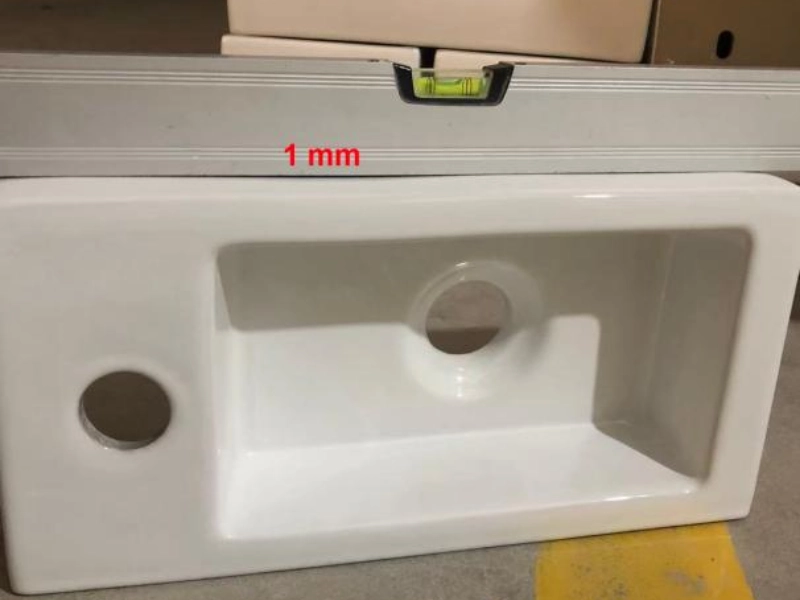
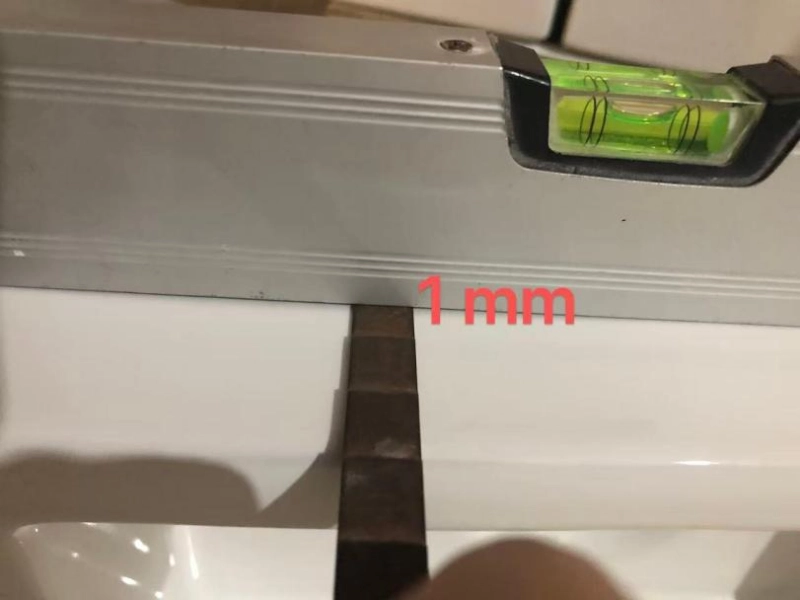
The standard also specifies maximum allowable deformation for different areas of sanitary ceramic products.
For washing basins and hand basins, the requirements distinguish between the installation surface, surface, overall deformation, and edge deformation. The standard specifies values such as 3 mm for the installation surface, 6 mm for the surface, and 4 mm for the edge, while overall deformation is measured differently. Round or artistic-shaped products may also be treated differently for edge deformation.
Therefore, a slight visual curve or dimensional variation does not automatically indicate poor workmanship.
Hole Dimensions and Position
Faucet holes, waste holes, and other openings also have specific tolerance requirements.
For example, GB/T 6952-2015 specifies different allowable deviations for hole diameters depending on their size, while hole center distance and hole position have their own requirements.
This is why buyers should evaluate installation-critical dimensions according to the applicable standard and agreed technical drawing rather than applying a universal ±1 mm tolerance to every hole.
Practical B2B Recommendation
For a custom ceramic basin project, buyers and manufacturers should agree on the following before mass production:
- Nominal product dimensions
- Critical installation dimensions
- Faucet-hole specifications
- Waste-hole specifications
- Mounting dimensions
- Acceptable dimensional tolerances
- Surface and deformation requirements
- Color and glaze requirements
- Inspection method
- Sampling and acceptance criteria
This creates a much clearer quality standard than simply stating that the product must be “exactly the same as the CAD drawing.”
3. Three Main Sources of Ceramic Basin Dimensional Variation
Minor dimensional variation in a ceramic basin does not necessarily mean poor workmanship. It is closely related to the physical characteristics of ceramic manufacturing.
3.1 Firing and Drying Shrinkage
Ceramic bodies experience dimensional shrinkage as moisture is removed and the material is fired.
Manufacturers compensate for expected shrinkage by designing molds and forming dimensions accordingly. However, the exact shrinkage rate can vary depending on factors such as:
- Raw material composition
- Moisture content
- Green-body density
- Drying conditions
- Kiln temperature
- Firing cycle
- Product geometry
- Position inside the kiln
As a result, two pieces manufactured from the same mold may not be mathematically identical after firing.
This is one of the most important differences between ceramic products and machined hardware.
3.2 Thermal Deformation During High-Temperature Firing
Ceramic sanitary ware must undergo high-temperature firing to develop its final physical properties.
During firing, the ceramic body experiences significant physical and chemical changes. Temperature distribution inside the kiln, product placement, product geometry, and the supporting method can influence the final shape.
Large, thin-walled, asymmetric, or unusually shaped products can be more sensitive to deformation.
A professional ceramic bathroom sink manufacturer therefore considers firing behavior during mold development and production rather than attempting to eliminate every possible millimeter of variation.
3.3 Manual Trimming and Finishing
Some ceramic basins require manual trimming, especially when they feature:
- Thin edges
- Irregular shapes
- Handmade-style designs
- Special corner profiles
- Customized dimensions
- Complex surface transitions
Minor differences can occur during edge trimming, leveling, and finishing.
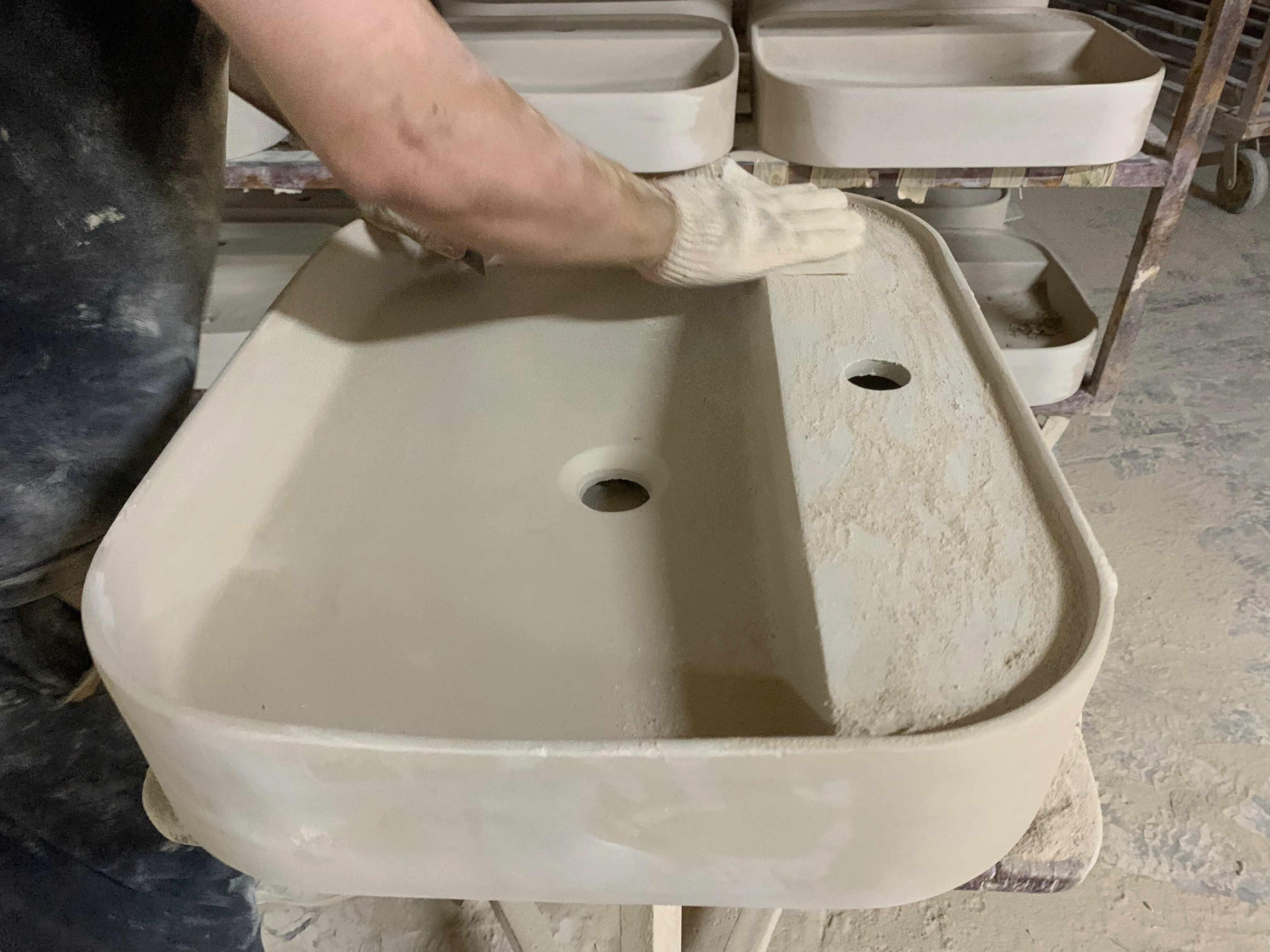
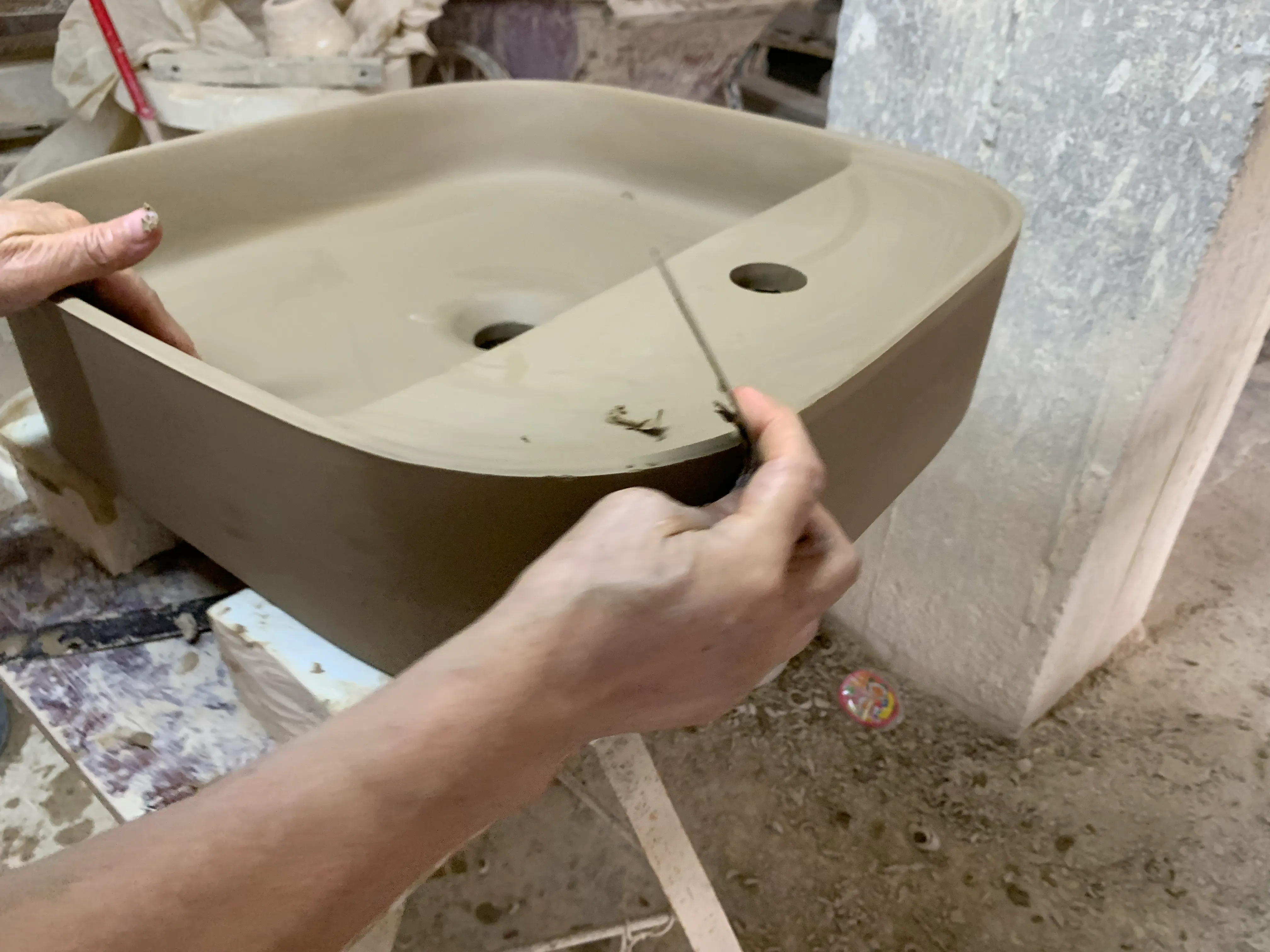
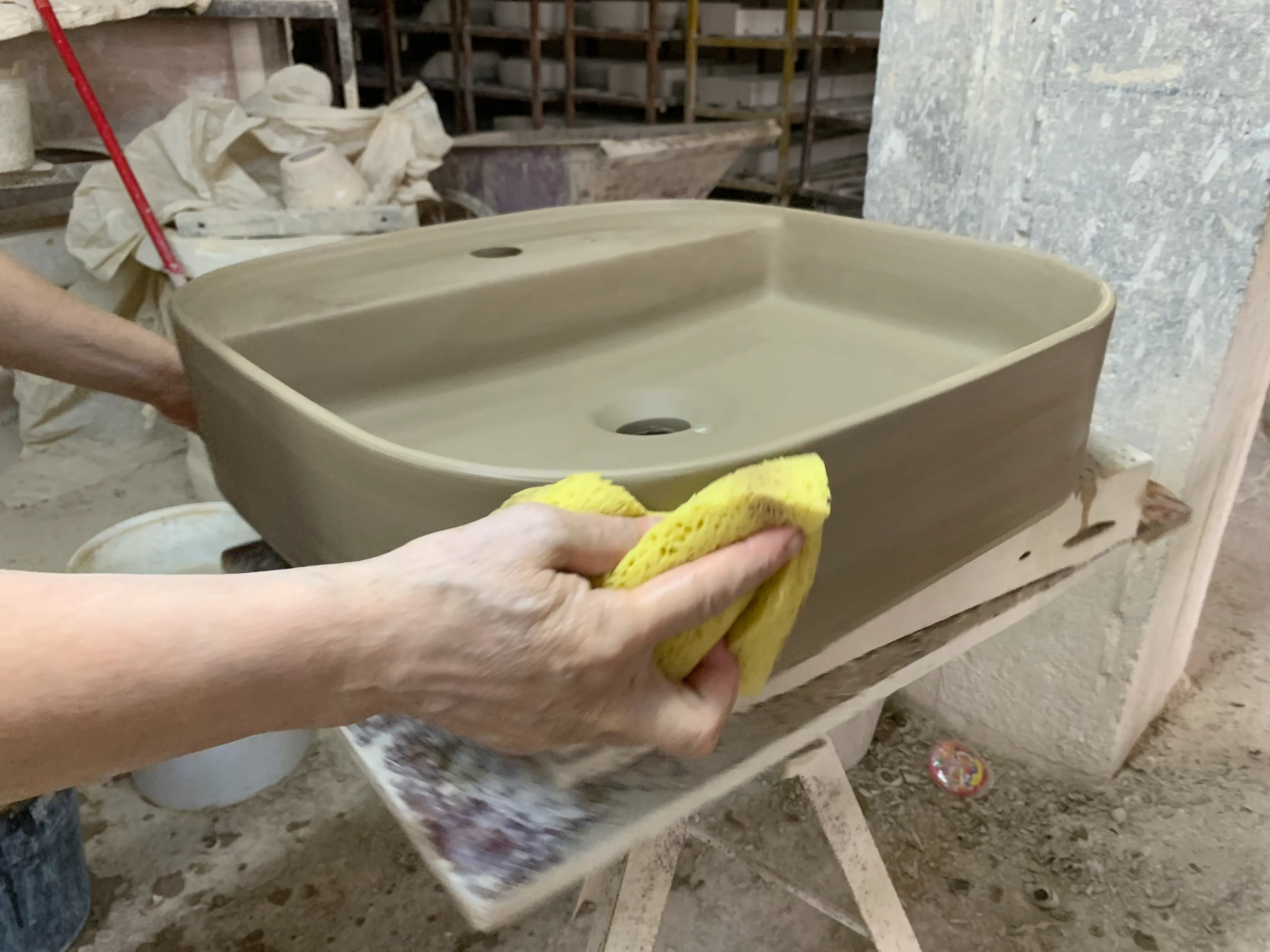
This does not mean that the manufacturer has poor process control. Instead, the appropriate question is whether the finished product remains within the agreed specification and maintains proper installation and functional performance.
4. Common Ceramic Basin Tolerance Misconceptions
Misconception 1: Two Identical Basins Must Have Exactly the Same Dimensions
Not necessarily.
Mass-produced ceramic products can have minor dimensional variation because each piece passes through drying and firing processes.
For a ceramic basin, the correct approach is to compare measurements against the agreed tolerance range rather than expecting two pieces to be mathematically identical.
Misconception 2: A Slightly Curved Rim Means the Product Is Defective
Not automatically.
Ceramic products can experience minor deformation during firing. Whether the deformation is acceptable depends on its location, degree, appearance, installation requirements, and the applicable standard or agreed specification.
For project applications, installation-critical surfaces should receive particular attention.
Misconception 3: A Small Hole Position Difference Means the Basin Cannot Be Installed
Again, not necessarily.
Hole dimensions and positions should be evaluated against the relevant requirements and the actual fitting system.
For mass production, a professional ceramic bathroom sink manufacturer should identify installation-critical dimensions before production and confirm them through drawings, samples, or technical specifications.
Misconception 4: The Physical Product Must Match the CAD Rendering Exactly
CAD drawings and 3D renderings are essential tools for product development, but they represent idealized geometry.
A rendering does not automatically account for:
- Ceramic shrinkage
- Firing deformation
- Glaze thickness
- Manual finishing
- Manufacturing tolerances
Therefore, a technical drawing should clearly identify which dimensions are critical and what tolerance applies to each one.
For B2B projects, this is much more reliable than using the visual appearance of a rendering as the only acceptance criterion.
5. How Buyers Should Define Ceramic Basin Tolerances
For importers, wholesalers, distributors, bathroom brands, and construction projects, tolerance requirements should be discussed before production rather than after goods arrive.
A professional sourcing process can include the following steps.
Step 1: Define the Nominal Dimensions
Specify the intended length, width, height, depth, wall thickness, hole diameter, and other important dimensions.
Step 2: Identify Critical Dimensions
Not every dimension has the same importance.
For example, the following may be more critical than decorative dimensions:
- Faucet-hole position
- Waste-hole position
- Mounting points
- Countertop opening
- Wall-mount dimensions
- Drain connection
- Installation surface
Step 3: Agree on Tolerances Before Production
Do not simply tell a ceramic bathroom sink manufacturer to “make it exact.”
Instead, define the acceptable tolerance for each critical dimension.
Step 4: Approve a Pre-Production Sample
For customized products, a physical sample provides a much more reliable reference than a rendering alone.
Buyers can inspect:
- Dimensions
- Shape
- Edge profile
- Hole position
- Surface finish
- Color
- Glaze
- Installation compatibility
Step 5: Establish a Clear Inspection Standard
A written inspection standard can prevent disputes after mass production.
It should specify the measurement method, measuring tools, sampling quantity, acceptable tolerance, and treatment of non-critical cosmetic variation.
6. Ceramic Basin Tolerance: What B2B Buyers Should Know
For a buyer sourcing a ceramic basin, the most important principle is simple:
Ceramic sanitary ware should be evaluated against agreed technical tolerances and applicable ceramic standards, not against zero-tolerance hardware precision.
GB/T 6952-2015 provides requirements for sanitary ceramic products, including deformation, dimensions, appearance, thickness, water absorption, crack resistance, and other technical characteristics. The standard is currently listed as an existing national standard, although a revision is under review.
This means that a professional purchasing specification should distinguish between:
Appearance requirements
Color, glaze, surface quality, edge appearance, and visible defects.
Dimensional requirements
Overall dimensions and specified dimensional tolerances.
Installation requirements
Hole positions, mounting surfaces, drainage connections, and other functional dimensions.
Functional requirements
Installation compatibility, durability, water drainage, and other project-specific requirements.
This approach makes quality inspection more objective and reduces misunderstandings between buyers and manufacturers.
7. Custom Ceramic Basin Solutions from HanYu
Founded in 2002, HanYu Sanitary Ware is an experienced ceramic bathroom sink manufacturer specializing in the production and wholesale supply of ceramic bathroom sinks for international markets.
HanYu has built market experience in countries including South Korea, Brazil, the Netherlands, and Singapore, serving global brands, distributors, wholesalers, and bathroom projects.
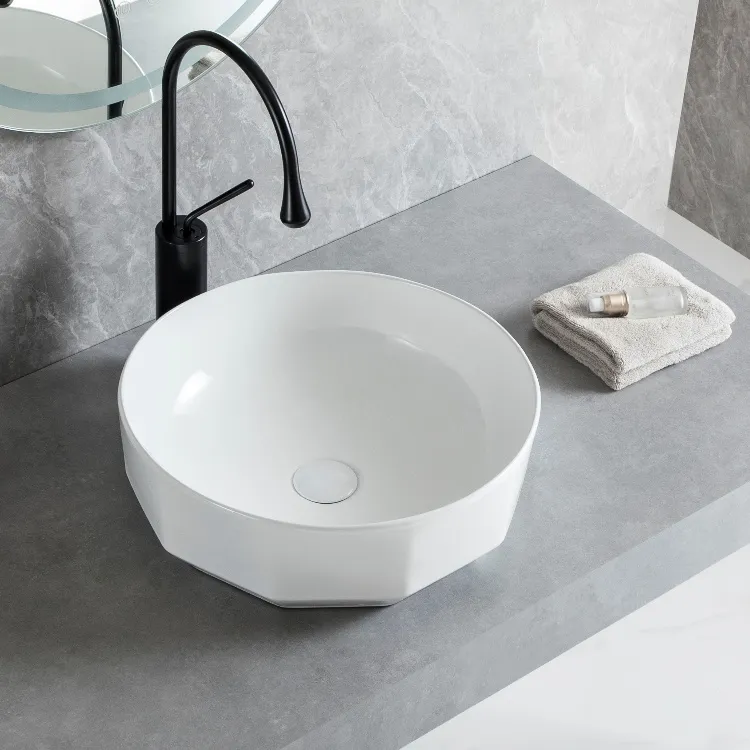
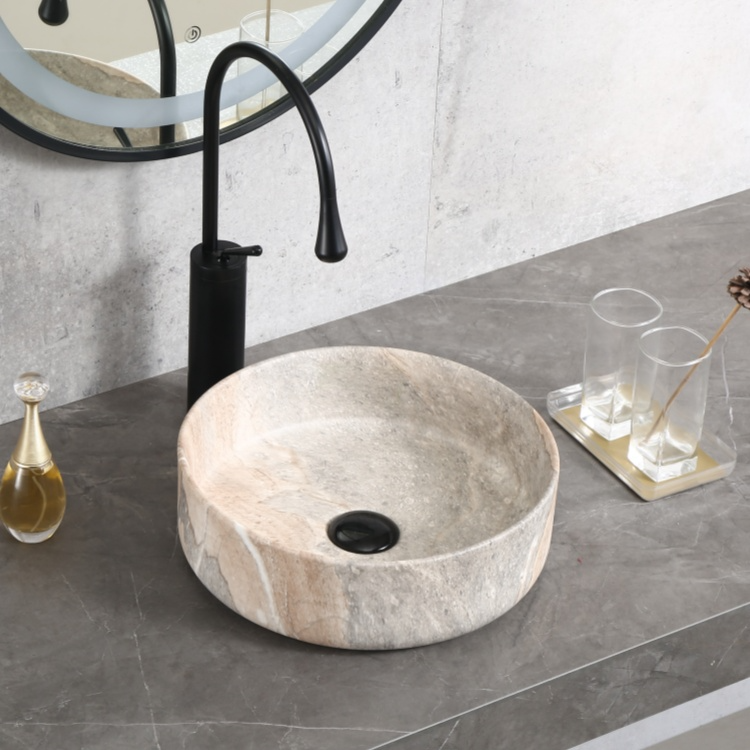
For buyers looking for flexible sourcing options, HanYu provides different levels of customization according to project requirements.
Existing Product Customization
For existing ceramic basin models, buyers can explore relatively straightforward customization options such as:
- Logo customization
- Color customization
- Surface treatment
- Packaging customization
- Other selected product finishing options
These solutions are suitable for brands, wholesalers, distributors, and retailers that want differentiated products without developing an entirely new basin.


New Shape and Size Development
When a project requires a new shape, structure, or specific dimensions, the development process is different from adjusting an existing product. The corresponding development cost, production requirements, and MOQ can therefore differ from those of existing-product customization.
This distinction allows buyers to select a more suitable sourcing solution based on their actual project requirements.
If you are looking for an experienced ceramic bathroom sink manufacturer for wholesale supply, product customization, or new ceramic basin development, HanYu Sanitary Ware can work with your team to evaluate the product specification, customization level, target quantity, and production requirements.