
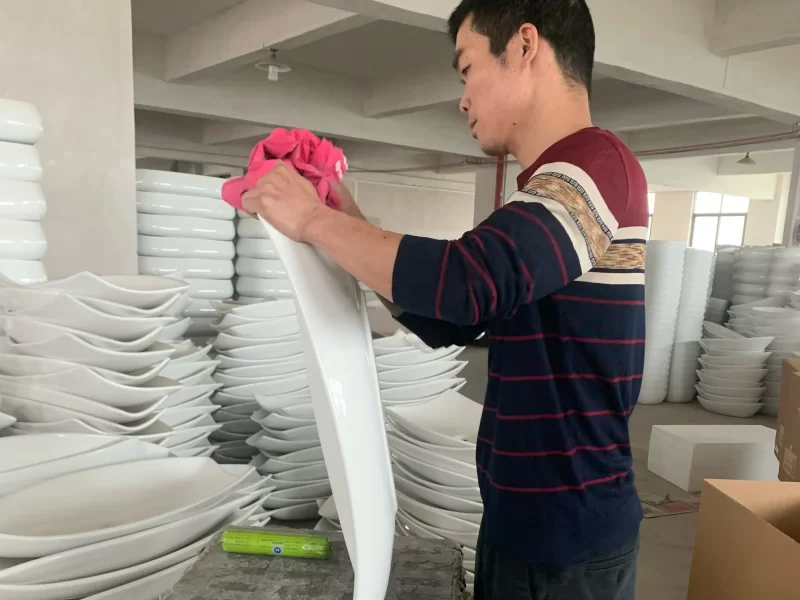
Ceramic sinks manufacturing involves multiple precision processes, including raw material preparation, slip casting, molding, drying, glazing, and firing. This guide explains the differences between traditional production, assembly-line manufacturing, and high-pressure molding to help global buyers choose reliable ceramic sink suppliers.
High-quality sanitaryware products require multiple stages of precise refinement. In ceramic sinks manufacturing, even a small deviation in raw materials, molding, drying, or firing can affect the final product quality.
For decades, ceramic sink production has combined traditional craftsmanship with modern technology. Today, manufacturers use different production methods, including manual slip casting, assembly-line production, and high-pressure molding, to meet different market requirements.
Understanding the ceramic sinks manufacturing process helps global importers, bathroom brands, and construction companies select the right supplier based on quality standards, production capacity, and customization needs.
Raw Materials Preparation in Ceramic Sinks Manufacturing
Ceramic sinks are mainly produced from silico-aluminous clay, including:
- Kaolin
- Quartz
- Feldspar
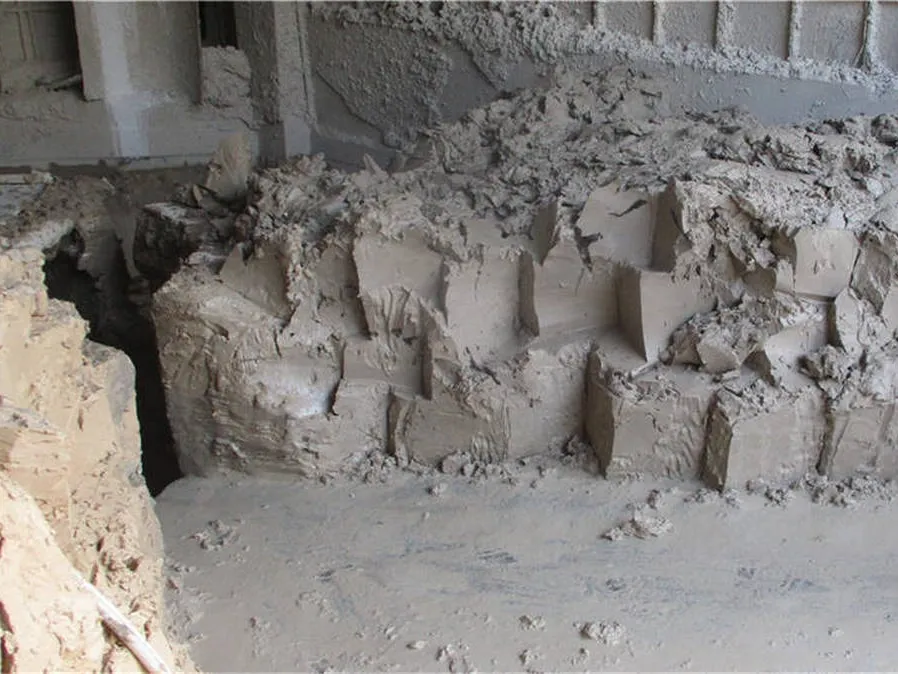
Additional materials such as talc and metal oxides are added to improve product performance, texture, and durability.
Before molding begins, raw materials must go through strict preparation procedures:
1. Raw Material Inspection and Cleaning
The clay is inspected, screened, and washed to remove impurities that may affect the final ceramic sink quality.
2. Grinding and Refinement
The materials are ground, sieved, and de-ironized to achieve suitable particle size and purity.
3. Slip Preparation
Through water filtration, aging, and kneading, manufacturers adjust the slip moisture content and plasticity to meet molding requirements.
A stable slip formula is one of the most important foundations of professional ceramic sinks manufacturing.
Three Main Ceramic Sinks Manufacturing Processes
Different factories use different ceramic sink production technologies depending on product type, order volume, and quality requirements.
The three major ceramic sinks manufacturing methods include:
- Traditional manual slip casting
- Assembly-line production
- High-pressure molding
1. Traditional Manual Slip Casting Production
Traditional manual production was one of the earliest methods used in China’s sanitaryware industry.
Workers place plaster molds on the ground and manually pour ceramic slip into molds. The forming process mainly depends on natural absorption and drying.
Advantages:
- Low equipment investment
- Flexible production
- Suitable for customized products
Disadvantages:
- High labor requirements
- Low production efficiency
- Large differences between products
- Limited production capacity
Because of its low standardization level, this method is mainly used for small-scale production, customized orders, or low-volume markets.
In modern ceramic sinks manufacturing, traditional production has gradually been replaced by more standardized methods.
2. Assembly-Line Ceramic Sinks Manufacturing
Assembly-line production represents a major upgrade in ceramic sink manufacturing technology.
Many small and medium-sized sanitaryware factories still use this production model today.
In this process:
- Ceramic molds are arranged on production lines
- Slip is supplied through pipelines
- Machines assist mold opening and closing
- Drying and handling processes are optimized
Compared with traditional manual casting, assembly-line ceramic sinks manufacturing significantly improves:
- Production efficiency
- Product consistency
- Labor productivity
- Quality control
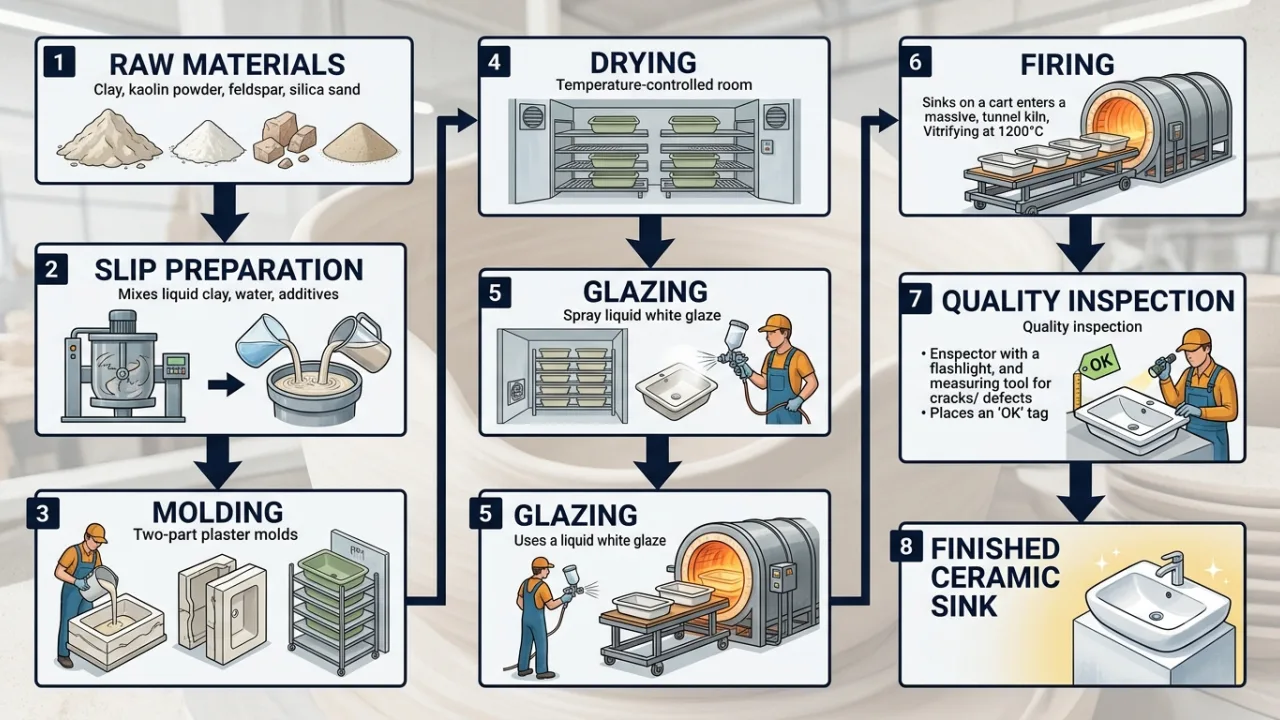
The production line covers multiple stages, including:
- Raw material preparation
- Molding
- Drying
- Glazing
- Firing
- Inspection
This method is suitable for large-volume orders of standard ceramic bathroom sinks.
3. High-Pressure Ceramic Sinks Manufacturing
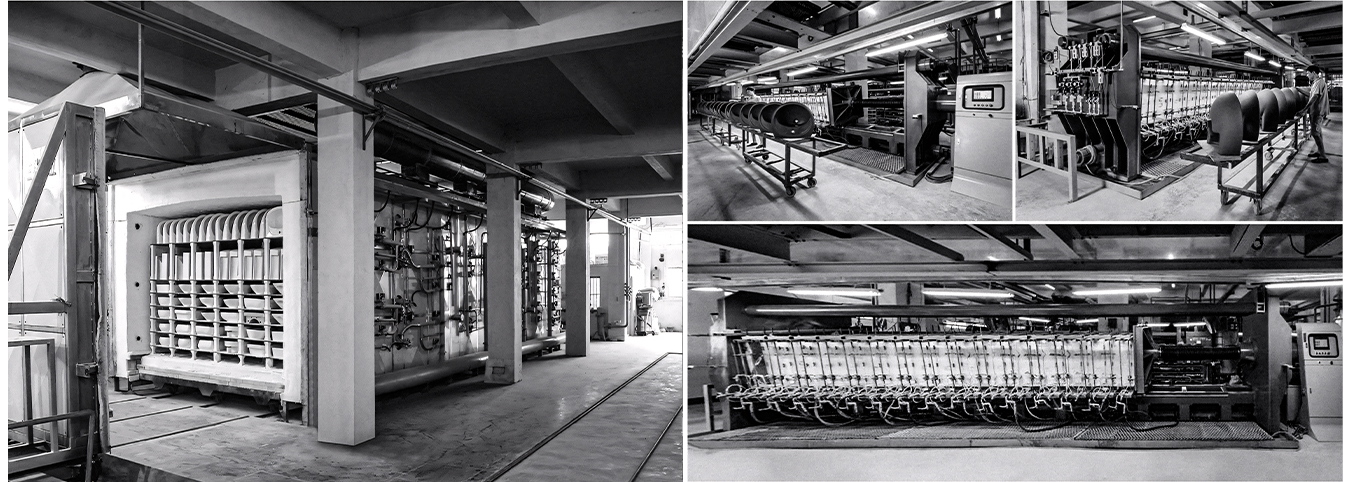
High-pressure molding represents the advanced direction of modern ceramic sinks manufacturing.
This technology uses specialized equipment to achieve high-density and high-precision molding.
Typical processes include:
- High-pressure ceramic slip casting
- Fiberglass compression molding
High-pressure casting can reach pressures above 1 MPa, while fiberglass compression molding may use pressure ranging from 500 to 2,500 metric tons.
Advantages:
- Short production cycle
- High dimensional accuracy
- Strong product consistency
- Reduced manual operation
The molding cycle can be reduced to approximately 10–16 minutes, while molds can achieve around 8,000–10,000 production cycles.
Limitations:
- High equipment investment
- Expensive molds
- More suitable for stable mass production
For premium bathroom brands and large construction projects, high-pressure ceramic sinks manufacturing provides stronger quality control and efficiency.
Comparison of Different Ceramic Sinks Manufacturing Methods
Production Scale and Efficiency
Traditional Manual Production
Suitable for:
- Small batch orders
- Customized designs
- Low-volume markets
However, production speed and capacity are limited.
Assembly-Line Production
Suitable for:
- Wholesale ceramic sinks
- Standard bathroom products
- Large-volume commercial orders
It provides a balance between production efficiency and manufacturing cost.
High-Pressure Production
Suitable for:
- Large-scale projects
- Premium bathroom products
- High-precision ceramic sinks
Although the investment is higher, it delivers excellent production consistency.
Product Quality and Manufacturing Cost Comparison
Traditional Production
Common issues include:
- Size deviation
- Uneven glaze
- Inconsistent appearance
Although the production cost is low, quality stability is limited.
Assembly-Line Production
Assembly-line ceramic sinks manufacturing provides:
- Stable quality
- Lower unit cost
- Faster delivery
It is currently the most widely adopted production method for mainstream sanitaryware products.
High-Pressure Production
High-pressure ceramic sinks manufacturing delivers:
- Higher density
- Better strength
- Superior appearance consistency
It is ideal for high-end bathroom projects requiring strict quality standards.
Application Scenarios of Different Manufacturing Processes
Traditional Manual Casting
Used for:
- Customized bathroom projects
- Small residential projects
- Special-shaped products

Assembly-Line Manufacturing
Used for:
- Standard ceramic wash basins
- Wholesale bathroom products
- Commercial building projects

High-Pressure Manufacturing
Used for:
- Luxury ceramic sinks
- Integrated bathroom products
- High-performance sanitaryware

The Future Development of Ceramic Sinks Manufacturing
The sanitaryware industry is moving from traditional craftsmanship toward intelligent manufacturing.
Traditional manual production represents the beginning of ceramic sink development.
Assembly-line manufacturing improves efficiency and standardization.
High-pressure molding represents the future direction of ceramic sinks manufacturing, combining automation, precision, and consistent quality.
This technological evolution reflects how China’s bathroom industry is transitioning from manufacturing to smart manufacturing.
FAQ About Ceramic Sinks Manufacturing
What materials are used in ceramic sink manufacturing?
Ceramic sinks are mainly made from kaolin, quartz, feldspar, and other additives. These materials provide strength, durability, and a smooth surface after firing.
Which ceramic sinks manufacturing process is best for large orders?
Assembly-line production is currently the most common choice for large-volume orders because it offers stable quality, efficient production, and competitive costs.
For premium projects requiring higher precision, high-pressure molding is a better solution.
How long does ceramic sink production take?
Production time depends on the manufacturing method, product design, and order quantity. Advanced ceramic sinks manufacturing processes can significantly reduce molding time while improving consistency.
How do buyers evaluate a reliable ceramic sink manufacturer?
Global buyers should consider:
- Factory experience
- Production technology
- Quality inspection system
- Certifications
- Export experience
- Customization capability
Partner with HanYu for Ceramic Sink Solutions
HanYu Sanitary Ware is a professional ceramic bathroom sink manufacturer with 20+ years of experience in ceramic sinks manufacturing. We provide OEM/ODM solutions, flexible customization, and reliable supply for global brands, distributors, and projects.
Looking for a trusted ceramic sink supplier? Contact HanYu for customized solutions and wholesale cooperation.